
Recently, researchers discovered a new amphibian species—the Ye's fat salamander—in the Huaiyu Mountain area.
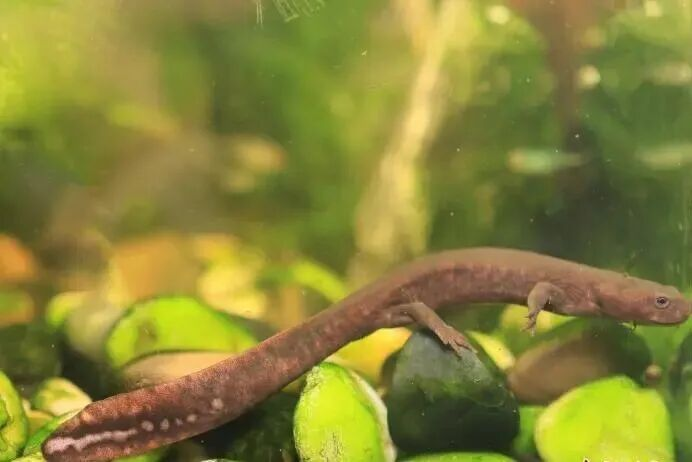
In April 2025, researchers photographed Ye's salamander. (Photo provided by Professor Zhang Baowei's research team at Anhui University)
Ye's salamander was discovered by researchers from Anhui University during a special survey of biodiversity conservation priority areas from Huangshan to Huaiyu Mountain. The related research paper has been published online in the internationally renowned journal *Asian Herpetological Research*.
It is reported that for a long time, the academic community generally classified the salamanders distributed in Huaiyu Mountain as Fei's salamander. In this study, the first author of the paper, Anhui University Ph.D. student Zhang Caiwen, confirmed through genetic and morphological analysis that the salamander discovered is a new species. The researchers named the new species Ye's salamander in honor of the famous Chinese zoologist Ye Changyuan.
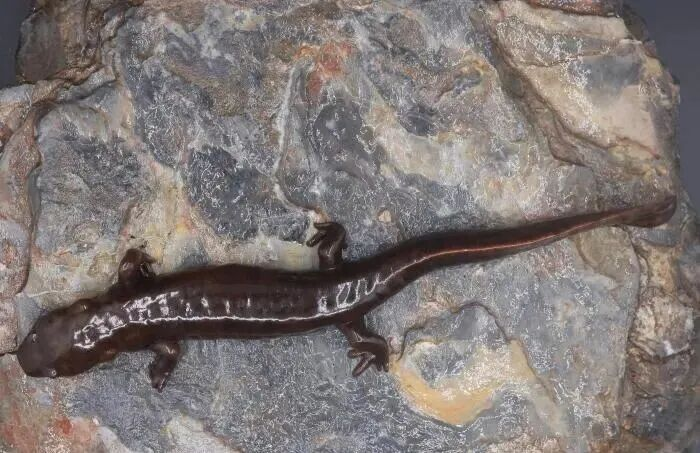
In April 2025, researchers photographed the Ye's Salamander. (Photo provided by Professor Zhang Baowei's research team at Anhui University)
Morphological characteristics show that the Ye's Salamander is dark brown all over, with orange-yellow patches on its belly, and a unique silver horizontal stripe on both sides of the tail tip. Compared with the closely related Fei's Salamander, the Ye's Salamander has a wider head and a broader, more robust chest. Detection data of the CYTB and ND2 gene sequences further confirm the validity of the new species: the genetic distances of these two gene sequences between Fei's Salamander and Ye's Salamander reach 5.5% and 7.1%, respectively.
The discovery of the Ye's Salamander is a new achievement in the baseline survey of biodiversity in China and directly demonstrates that the species resources in the subtropical mountainous areas of eastern China, represented by Huaiyu Mountain, are rich and the ecology is unique, indicating that there is still considerable potential for exploring regional biodiversity resources.

