
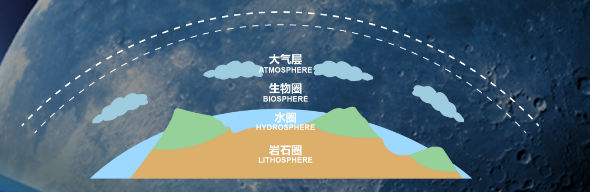
The Earth has a typical structure of concentric rings. On one hand, sold pats are divided into crust, mantle, and core from the surface to the center, forming the three inner circles of the Earth. On the other hand, the flowing atmosphere, lively hydrosphere and vibrant biosphere are the three outer circles of the Earth.
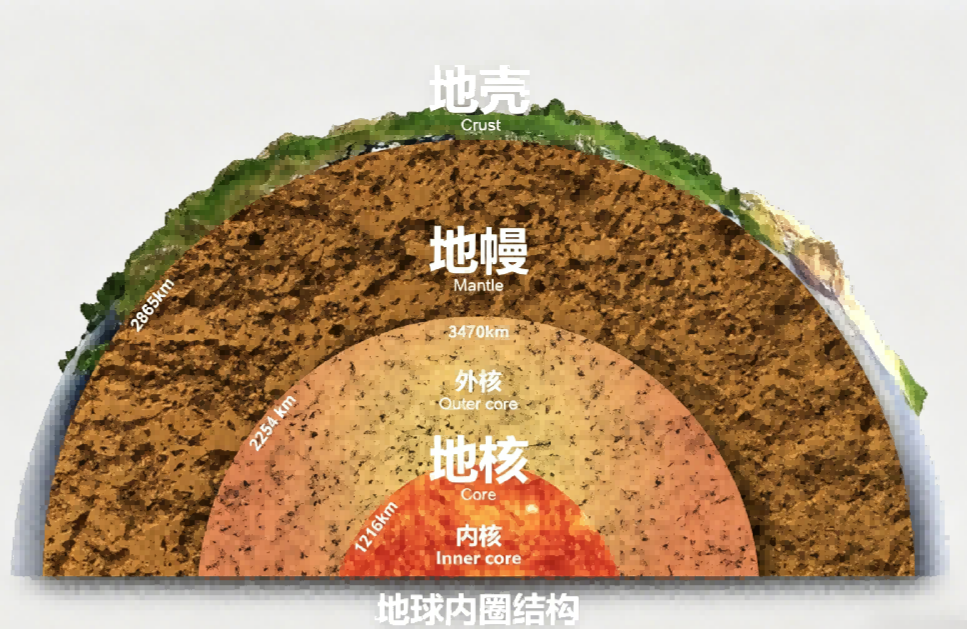
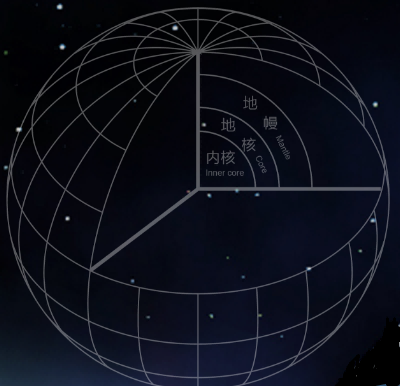
The internal structure of the Earth is a concentric ring structure, which is divided into core, mantle, and crust from the center of the Earth to its surface. The interface between Earth's core, mantle, and crust is mainly determined by the rapid changes in the propagation speed of seismic waves.
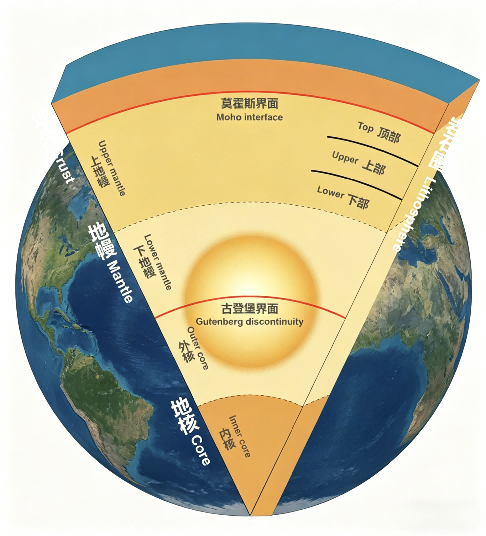
The crust is a solid shell composed of rocks. It is the outermost layer of the Earth's solid ring and an important part of the lithosphere. Judging from the study of seismic waves, the boundary between the crust and the mantle is the Moholovicic discontinuity (the Moho).
The mantle is below the Earth's crust and above the Earth's core. It is the middle layer of the Earth and has a thickness of about 2865 km. It is mainly composed of dense rock-forming materials. It is the largest and most massive layer in the Earth's interior. The mantle can be divided into layers, which are the upper mantle and the lower mantle.
The core is the core of the Earth, located in the innermost part. The radius of the core is about 3470 km. It is mainly composed of iron (Fe) and nickel (Ni). The average density of core is about 10.7g/cm3, which is very high. The temperature is also very high, which can reach 7000°C. The core can be divided into inner core and outer core.
The inner core is located in the innermost part of the Earth with a thickness of about 1,216 km. The average density is increased to 12.9g/cm3. The main components are iron (Fe) and nickel (Ni) based heavy metals, therefore it is also called iron-nickel cores.
The outer core is located above the solid inner core and under the mantle. It is composed of liquid iron (Fe) and nickel (Ni), with a thickness of about 2254 km.
 |
 |

