Fold Structures: Fold structures refer to the formations in the Earth's crust where rock layers have been subjected to intense tectonic forces, causing the layers to bend while maintaining continuity. In short, the bending of rock layers due to force is called folding. Folding phenomena are most evident in layered rock formations and are a common geological structural form in the crust, with varying scales. Small-scale folds can be seen in hand specimens, while large ones can extend hundreds of kilometers.
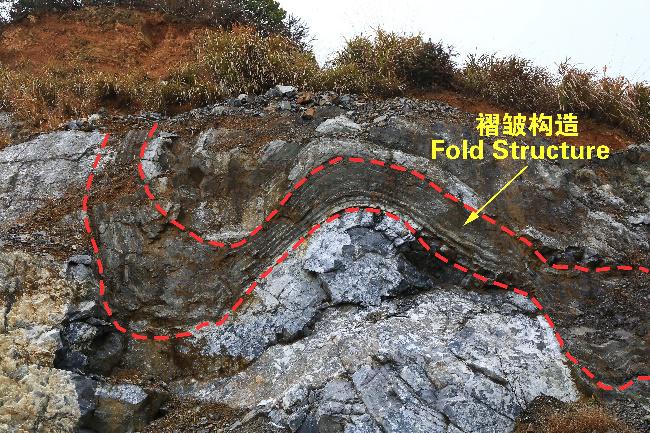
The fold structures here are composed of Cambrian banded limestone formed over 500 million years ago. Among them, the upward-bending parts are called "anticlines," and the downward-bending parts are called "synclines."
Did you know?
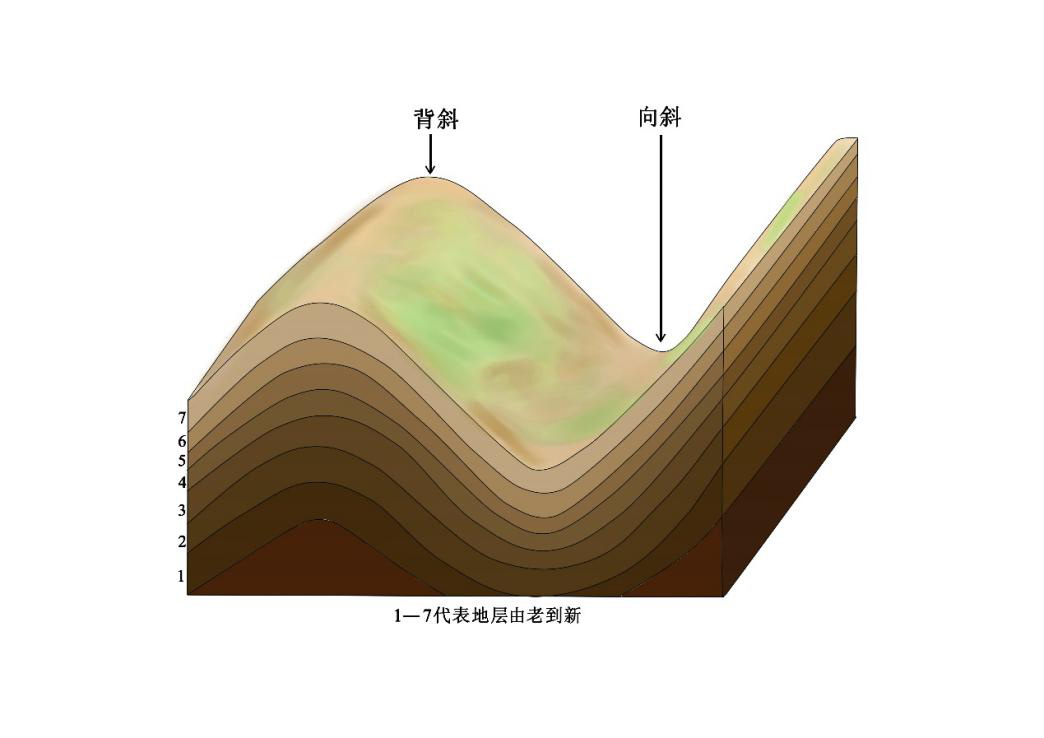
Anticlines and synclines are the two basic forms of folds. If we classify folds according to the relative age and morphological features of the stratified layers, folds can be divided into two basic types—anticlines and synclines.
Syncline: the term means 'downward inclination,' referring to folds whose two limbs extend upward while the center bends downward. The core consists of younger rock layers, and the limbs are composed of older rock layers.
Anticline: generally appears as an upwardly protruding curve. Layers dip outward from the center, with older rock layers in the core and younger rock layers in the limbs.
Originally flat rock layers undergo plastic bending deformation due to compressive forces. A single bend is called a flexure, while multiple wave-like bends are called folds. Folds are a common geological structure in the Earth's crust. Large folds can extend for thousands or even hundreds of kilometers, while small ones may only be a few centimeters or only visible under a microscope.
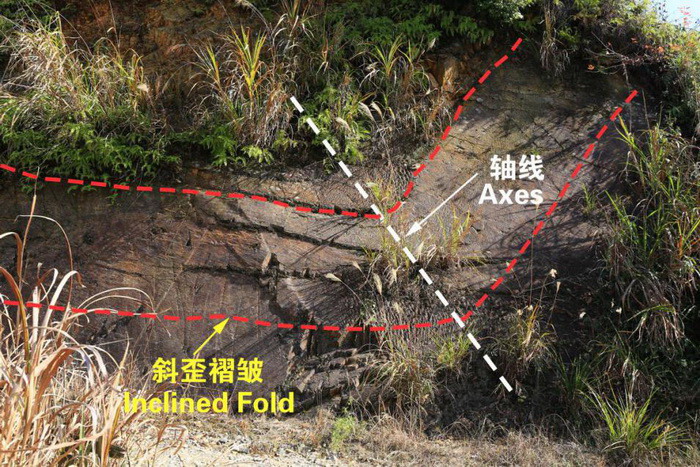
The folds here are composed of Ordovician sandstone and shale layers. The axial planes of the folds are inclined, with limbs dipping in opposite directions at unequal angles, forming oblique folds.
Originally flat rock layers undergo plastic bending deformation due to compressive forces. A single bend is called a flexure, while multiple wave-like bends are called folds. Folds are a common geological structure in the Earth's crust. Large folds can extend for thousands or even hundreds of kilometers, while small ones may only be a few centimeters or only visible under a microscope.