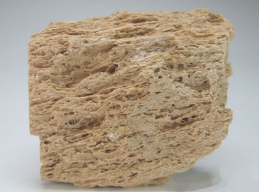
Igneous rocks are those that started as a hot, molten liquid called magma. The term “igneous” comes from a Greek word that means “from fire”. Magma from deep underground rises along fractures toward the Earth's surface. If they make it all the way, the liquid rock erupts and is called lava. As the layers of lava build up they form a mountain called a volcano. Volcanic rocks cool rather quickly, so large minerals crystals do not have a chance to form. Some typical volcanic rocks include obsidian, basalt, and pumice.
In many cases magma does not have enough energy to make it all the way to the surface. Instead it cools slowly deep underground. This is a slow process that allows large mineral crystals to form. Rocks that form this way are called “plutonic rocks”, named after Pluto, the Greek god of the underworld. We find these rocks at the Earth’s surface only after erosion has worn away the layers of rock above. Some of the most common plutonic rocks are granite, diorite, and gabbro.
There are two basic types: 1) intrusive igneous rocks such as diorite, gabbro, granite and pegmatite that solidify below Earth’s surface; and 2) extrusive igneous rocks such as andesite, basalt, obsidian, pumice, rhyolite and scoria that solidify on or near Earth’s surface.
Andesite is a fine-grained, extrusive igneous rock composed mainly of plagioclase with other minerals such as amphibole, pyroxene and biotite.
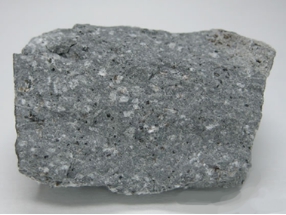
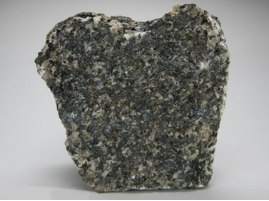
Gabbro is a coarse-grained, dark colored, intrusive igneous rock containing plagioclase, pyroxene, and sometimes olivine.
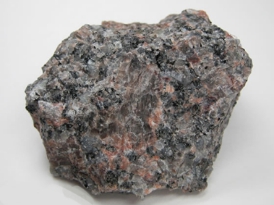
Granite is a coarse-grained, light-colored intrusive igneous rock containing mainly quartz, potassium, feldspar and plagioclase.
Pumice is a light-colored porous, glassy extrusive igneous rock. It forms extremely rapid cooling of magma. Its porous texture is created by volatile gases expanding and escaping during the cooling of the magma.