
The rock cycle refers to the continuous transformation and recycling of rocks at and beneath Earth’s surface driven by natural geological processes, analogous to the planet’s metabolic system that enables perpetual interconversion among the three major rock categories.
Magma solidifies upon cooling to form igneous rocks. Pre-existing rocks such as igneous and metamorphic rocks undergo weathering, erosion, transportation, sedimentation, compaction and cementation to turn into sedimentary rocks. Subjected to high temperature, high pressure and chemical fluids deep underground, existing rocks recrystallize and alter in composition to develop into metamorphic rocks. All types of rocks may sink back into the deep crust and remelt into magma once again.
Linking crustal movement, weathering and erosion, sediment transport and lithification, this ongoing cycle constantly remodels landforms and renews crustal materials, ranking among Earth’s most fundamental and vital geological processes.
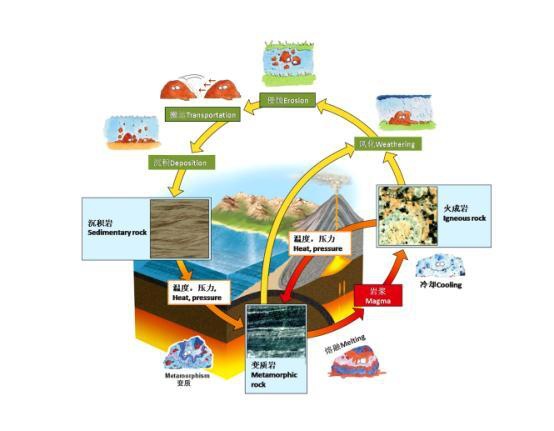
Far beyond simple rock-to-rock conversion, the rock cycle facilitates mass and energy exchange across Earth’s spheres, bridging the planet’s interior and outer surface. Originating from the upper mantle, magma crystallizes into igneous rock. Weathering, erosion and sediment transport rely on combined forces from the atmosphere, hydrosphere and biosphere to produce sedimentary deposits. Metamorphism of subsurface rocks is closely tied to tectonic crustal movement.
As a vital interconnecting link for the lithosphere, mantle, atmosphere, hydrosphere and biosphere, the rock cycle drives cyclic material flow between Earth’s interior and exterior, serving as a tangible manifestation of how the planet’s layered geosystem functions.

