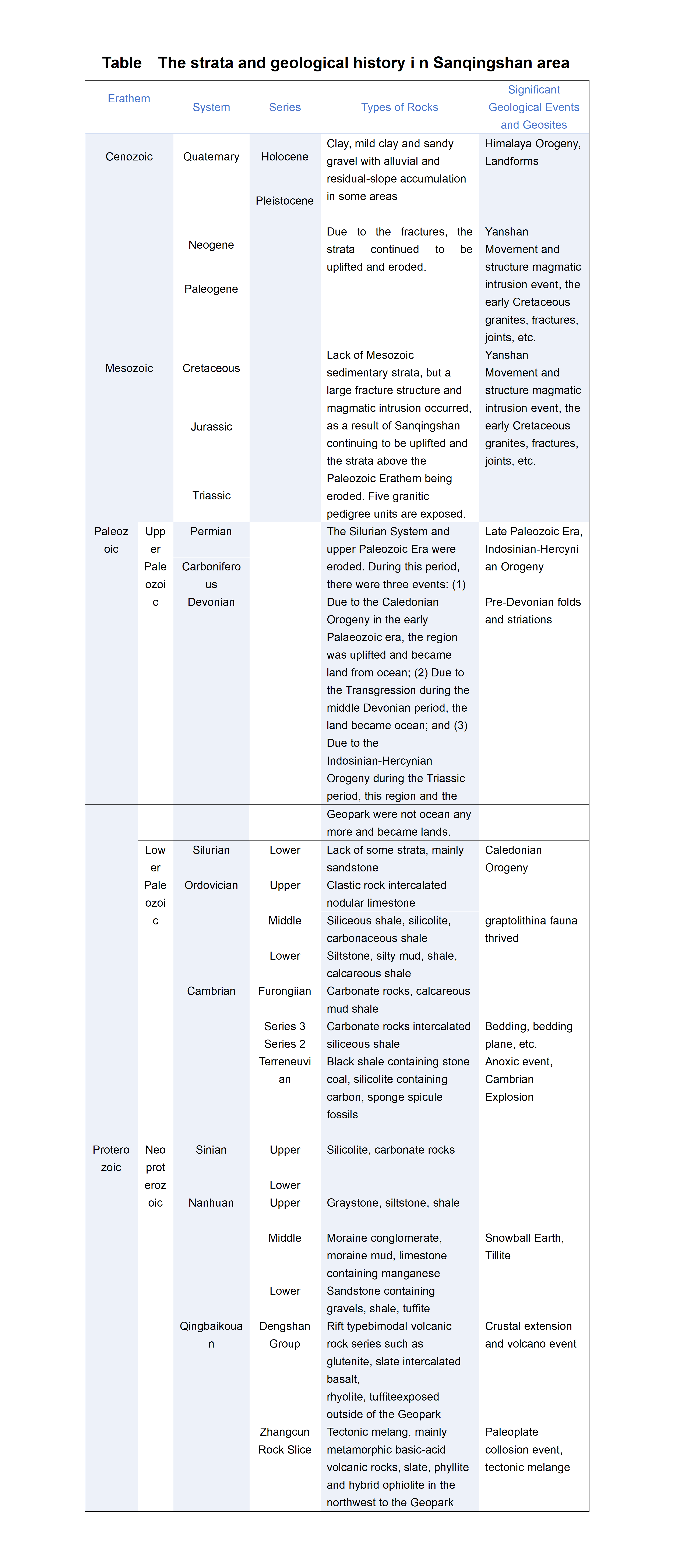
The Sanqingshan UGGp features a comprehensive stratigraphic record, with exposures ranging from the Neoproterozoic to the Quaternary within the Geopark and its surrounding areas. These strata chronicle the region's geological evolutionary history and significant geological events since the Neoproterozoic Era.
The Nanhua System (Neoproterozoic) consists of marine clastic rocks and tillites, intercalated with limestones. The overlying Sinian System is composed of siliceous rocks and carbonate rocks. Both systems are exposed in the core of the Geopark's anticlinorium.
Paleozoic strata are also well represented. The Cambrian and Ordovician systems are mainly distributed around the periphery of Sanqingshan. Strata from the Silurian through the Upper Paleozoic have been largely denuded within the park itself and are only exposed outside its boundaries. The Cambrian System comprises carbonate rocks intercalated with argillaceous and siliceous shales, with characteristic black shales at its base containing sponge spicule fossils. The Ordovician System consists primarily of shales intercalated with nodular limestones, yielding abundant graptolite fauna fossils. The Silurian System is composed of pelitic-arenaceous clastic rocks. The Devonian System consists of conglomerates, quartz sandstones, and siltstones, which generally rest unconformably on pre-Devonian strata. The Carboniferous and Permian systems are composed mainly of carbonate rocks.
The areas in dark grey show that no stratum was exposed in the Geopark (Qingbaikouan System) or the strata were eroded when they were uplifted (the Upper Paleozoic Erathem) or the strata were not deposited (Mesozoic Erathem), see the explanation in the table.
No Mesozoic strata are exposed inside the Geopark and they are distributed in the continental faulted basin outside of the Geopark. However, five early Cretaceous intrusive pedigree units which are a part of Mesozoic Huaiyushan granite batholith (Huaiyushan series) are exposed in the Geopark.
Only Quaternary strata including Pleistocene and Holocene series in Cenozoic Erathem are exposed in the Geopark, mainly in ravines and flatlands. The main rock layers are clay layer, mild clay layer and sandy gravel layer with alluvial or residual-slope accumulation gravel clay layer.