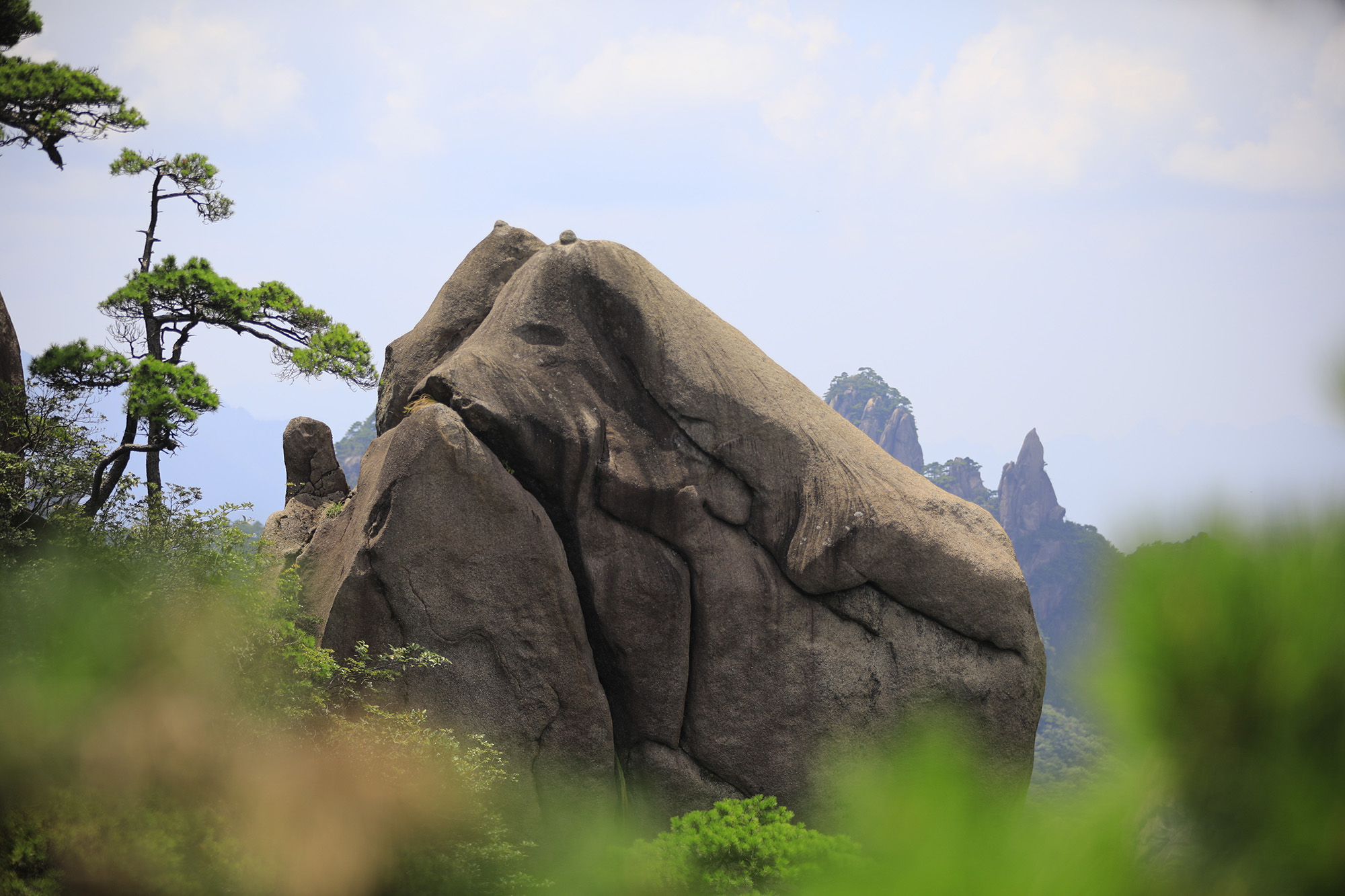
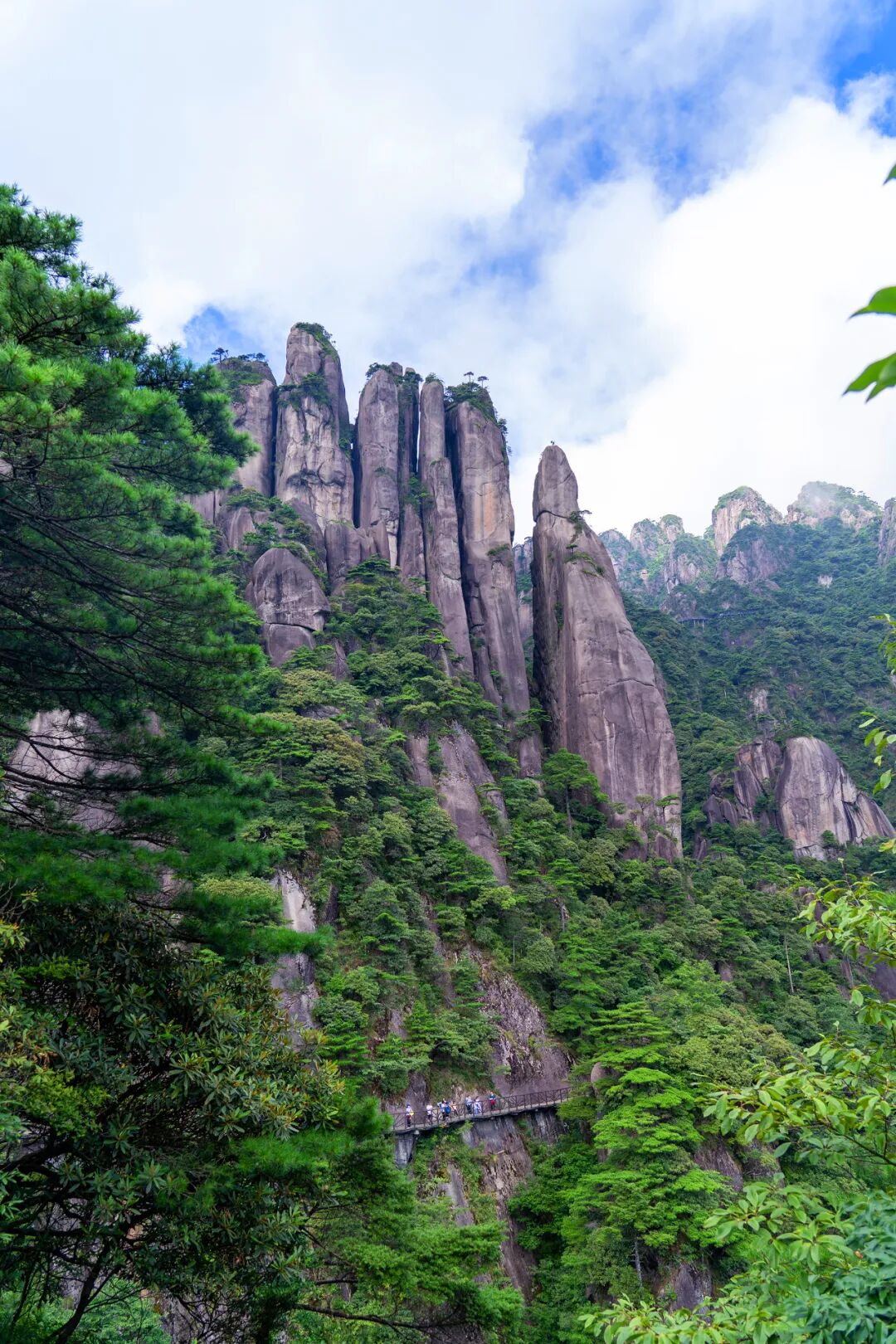
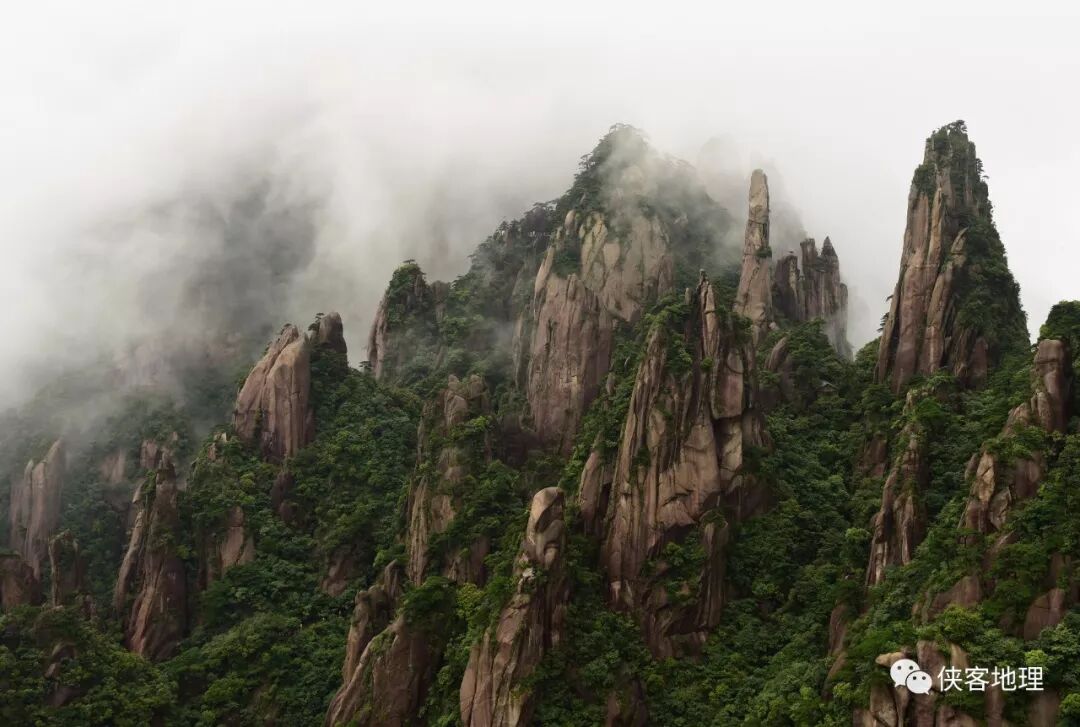
Magmatic activity in Sanqingshan and its surrounding areas began in the Middle to Neoproterozoic era, with the most frequent and intense magma activity during the Yanshan stage of the Mesozoic era. Granite exhibits the "two belts, three types" characteristics, forming a typical granite field.
The Middle to Neoproterozoic M-type oceanic plagioclase granite is mixed and distributed in the Xiwan metamorphic olivine north of Sanqing Mountain. According to research by Shu Liangshu et al. (1995), this rock is a differential product of basic components in the ophiolite sheath. On the fault contact zone between Xiwan metamorphic olivine and phyllite, high-pressure metamorphic blueamphibole schist can be seen.
Yanshanian granite exhibits the "two belts, three types" characteristics.
"Two Belts": the northern belt is the Tongchang–Yinshan structural magma belt, which is a mid-to-late Jurassic acidic shallow-formed porphyry to submerged volcanic belt. These rock masses appear as small rock stumps and rock formations, characterized by subterranean landforms; The southern zone is the Huaiyushan–Lingshan structural magma belt, spread across the Huaiyu Mountain area and its southeastern side. It is a Cretaceous granite belt mainly composed of the Lingshan and Huaiyushan rock bases. According to geophysical data, the two are deeply connected to form the Huaiyu Mountain Range, which is an important landscape-forming rock.
"Three types": refers to the three types of granite exposed in the Sanqing Mountain area, namely Type I, Type S, and Type A. The ages range from early to late, with genesis types ranging from type I→ type S → type A, and the overall rock composition has evolved toward superacidic and alkaline characteristics.
Igneous rock
Magmatic activity in Sanqingshan and its surrounding areas began in the Middle to Neoproterozoic era, with the most frequent and intense magma activity during the Yanshan stage of the Mesozoic era. Granite exhibits the "two belts, three types" characteristics, forming a typical granite field.
The Middle to Neoproterozoic M-type oceanic plagioclase granite is mixed and distributed in the Xiwan metamorphic olivine north of Sanqing Mountain. According to research by Shu Liangshu et al. (1995), this rock is a differential product of basic components in the ophiolite sheath. On the fault contact zone between Xiwan metamorphic olivine and phyllite, high-pressure metamorphic blueamphibole schist can be seen.
Yanshanian granite exhibits the "two belts, three types" characteristics.
"Two Belts": the northern belt is the Tongchang–Yinshan structural magma belt, which is a mid-to-late Jurassic acidic shallow-formed porphyry to submerged volcanic belt. These rock masses appear as small rock stumps and rock formations, characterized by subterranean landforms; The southern zone is the Huaiyushan–Lingshan structural magma belt, spread across the Huaiyu Mountain area and its southeastern side. It is a Cretaceous granite belt mainly composed of the Lingshan and Huaiyushan rock bases. According to geophysical data, the two are deeply connected to form the Huaiyu Mountain Range, which is an important landscape-forming rock.
"Three types": refers to the three types of granite exposed in the Sanqing Mountain area, namely Type I, Type S, and Type A. The ages range from early to late, with genesis types ranging from type I→ type S → type A, and the overall rock composition has evolved toward superacidic and alkaline characteristics. ...