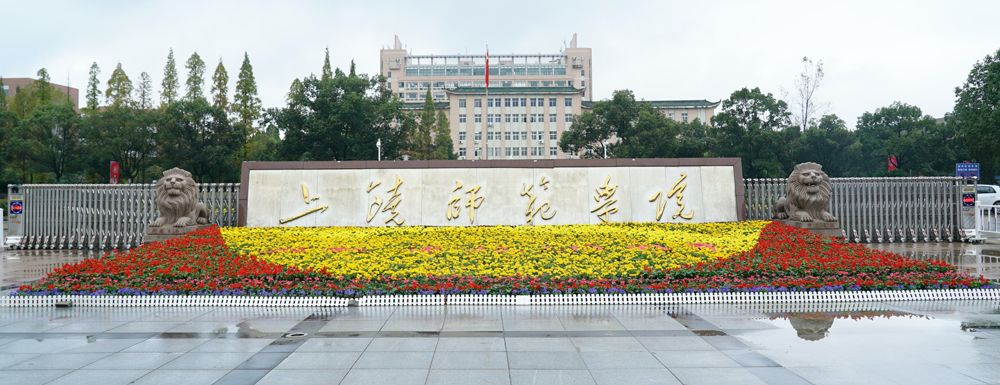
The predecessor of Shangrao Normal University was Shangrao Teachers' College founded in 1958. It was renamed Northeast Jiangxi University in 1959, suspended during the "Cultural Revolution", and resumed operation in 1977. With the joint approval of the Ministry of Education and the People's Government of Jiangxi Province in March 2000, it was officially upgraded to Shangrao Normal University. In 2024, the university successfully obtained the qualification of a master's degree-granting unit, and passed the Undergraduate Education and Teaching Audit and Evaluation of the Ministry of Education with excellent results in the same year. It was praised by experts as "a cradle rooted in the old revolutionary base area of Jiangxi, serving as a talent training highland in Northeast Jiangxi and a backbone of basic education teaching and management".
As of November 2025, the university has two campuses: Xinzhou and Yiyang, covering a total area of more than 1,600 mu. It has more than 16,000 full-time students and over 1,200 faculty and staff, including 328 doctoral students, with a continuously optimized faculty structure.
The university has 14 secondary colleges, 3 professional master's degree authorization points in Education, Electronic Information and Physical Education, and offers 41 undergraduate majors. It has 5 provincial key disciplines and 19 provincial-level scientific research platforms (including co-constructed ones). Among them, Chemistry and Mathematics and Applied Mathematics are national characteristic majors, and 7 majors including Physical Education, Physics, Chemistry, Mathematics and Applied Mathematics, Ideological and Political Education, Educational Technology and Calligraphy are provincial first-class undergraduate major construction sites. In recent years, closely following the requirements of the "1269" Action Plan for the Modernization of Key Manufacturing Industry Chains in Jiangxi Province, the university has added 6 applied majors including Artificial Intelligence, Smart Agriculture, Sports Tourism, Data Computing and Application, Optoelectronic Information Materials and Devices, and Materials Science and Engineering, accurately meeting the needs of regional industrial development.
Learn More: Shangrao Normal University