
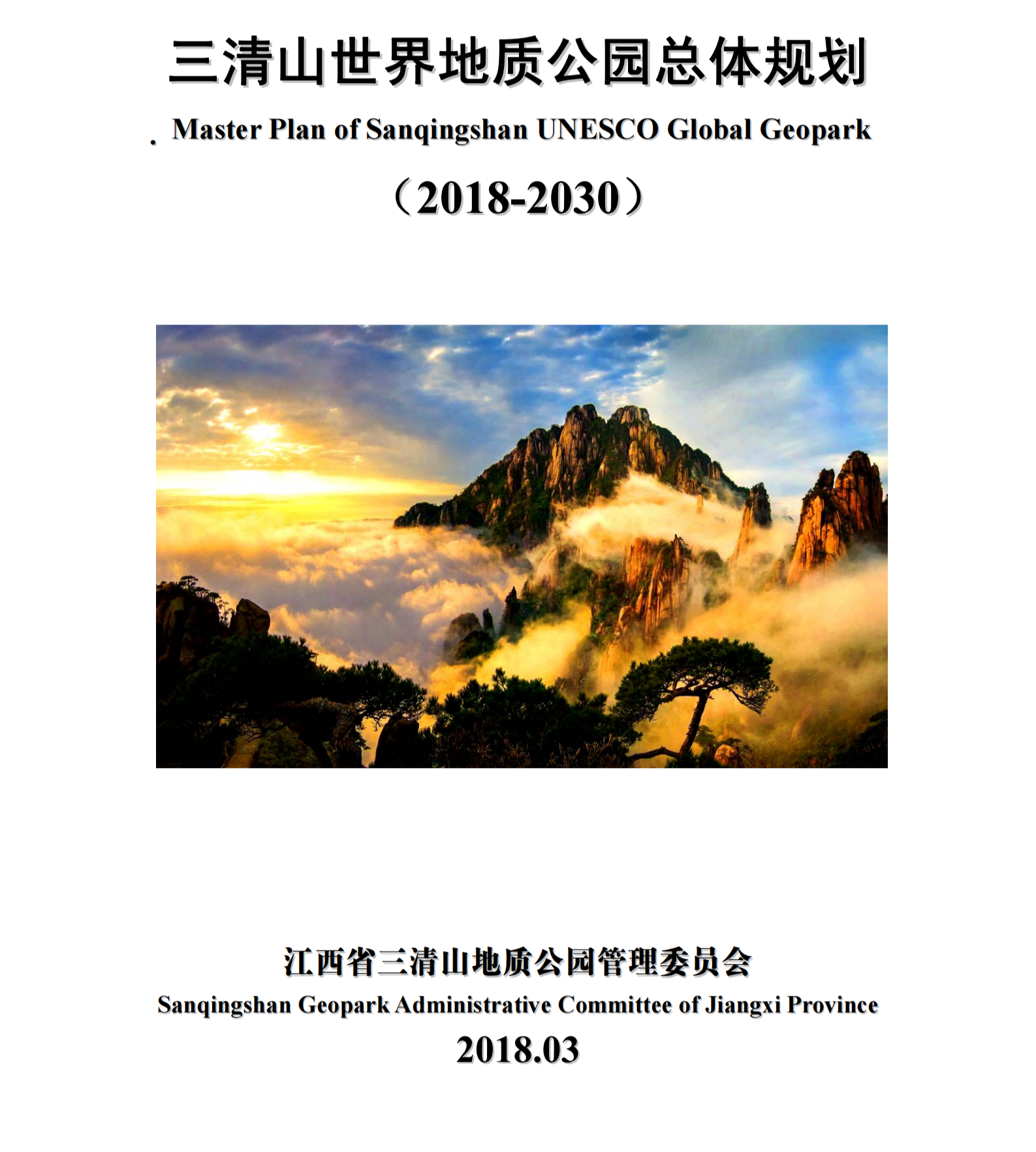
In 2018, the Sanqingshan Geopark Administrative Committee issued the Master Plan of Sanqingshan Global Geopark (2018–2030) (hereinafter referred to as “the Plan”), which drew an overall blueprint for the high-quality and sustainable development of the Geopark. The Plan systematically defines key tasks for the short-term, medium-term and long-term periods, covering major fields including planning background and scope, the protection of geoheritage sites, the conservation of natural and cultural heritage, resources and environmental protection, Geopark management, scientific research, construction of interpretation system, science popularization and education, geotourism development, informatization construction, infrastructure and tourism development, community development, key projects and funding support, and sustainable development strategies.
The overall development philosophy established by the Plan:
Touring on the mountain, staying at the foot; visiting the Geopark, staying in the town; viewing scenery on the mountain, relaxing in the park, entertaining in towns and cities.
Relying on the unique geological and ecological resources of the Geopark, the Plan coordinates the advantages of service facilities and convenient transportation in surrounding towns, promotes resource complementarity, functional linkage and coordinated development across the whole region, enabling tourists from home and abroad to enjoy the geological wonders and natural ecological beauty of Sanqingshan. Focusing on the whole industrial chain of “eating, accommodation, transportation, sightseeing, entertainment and shopping”, service quality will be comprehensively improved. New forms of tourism will be actively developed, including cultural experience, business conferences, leisure and vacation, health and wellness tourism, emotional study tours, scientific investigation and exploration, so as to continuously enrich the supply of tourism products.
The overall objectives proposed in the Plan:
From an international perspective, build Sanqingshan into a world-famous mountain scenic area, a world-class tourist, leisure and vacation destination, and a national science popularization and education base. Develop it into a demonstration zone for the strict protection and scientific utilization of geoheritage and ecological environment, and a model of harmonious coexistence between human and nature.
By 2025, strive to achieve an annual tourist reception capacity of 3 million person-times, annual ticket income exceeding 300 million yuan, and double the community residents’ income compared with 2015.
By 2030, double the number of tourist arrivals, ticket income and community residents’ income again on the basis of 2025, so as to comprehensively drive the high-quality development of the tourism economy in the Geopark and surrounding areas.
Framework of the Plan:
Chapter 1 Planning Background and Scope
• Article 1 Current Situation of Protection and Development of the Geopark
• Article 2 Development Potential of the Geopark
• Article 3 Background of the Formulation of the Plan
• Article 4 Planning Scope
• Article 5 Planning Boundaries
• Article 6 Nature and Period of the Plan
Chapter 2 Planning Basis
• Article 7 Basis of National Laws and Regulations
• Article 8 Basis of Technical Specifications, Standards and Guidelines
• Article 9 Basis of Local Laws, Policies and Plans
• Article 10 Other Bases and Relevant Materials
Chapter 3 Guiding Ideology and Development Goals
• Article 11 Guiding Ideology for Development
• Article 12 Overall Development Objectives
• Article 13 Objectives for Protection of Geoheritage
• Article 14 Objectives for Conservation of Other Natural and Cultural Heritage
• Article 15 Objectives for Geotourism Development
• Article 16 Objectives for Agricultural Development
• Article 17 Objectives for Forestry Development
• Article 18 Objectives for Science Popularization and Education
• Article 19 Objectives for Community Development
Chapter 4 Geoheritage (Geoheritage and Landscapes)
• Article 20 Attributes and Characteristics of the Geopark
• Article 21 Geological Diversity
• Article 22 Landform Diversity
• Article 23 Brief History of Geological Evolution of Sanqingshan
• Article 24 List and Characteristics of Geoheritage Sites
• Article 25 Comprehensive Evaluation of Geoheritage Values
• Article 26 Grade Evaluation of Geoheritage Values
• Article 27 Evaluation of Exploitable and Utilizable Potential of Geoheritage
Chapter 5 Other Natural and Cultural Heritage
• Article 28 Biodiversity Heritage
• Article 29 Cultural Heritage
• Article 30 Relationships Between Natural and Cultural Heritage
Chapter 6 Resources and Environmental Protection
• Article 31 Implementation of Environmental Capacity Control and Ecological Environment Protection
• Article 32 Protection of Geoheritage
• Article 33 Protection of Other Natural Heritage
• Article 34 Protection of Cultural Heritage
• Article 35 Disaster Prevention and Control
Chapter 7 Geopark Management
• Article 36 Analysis of Strengths and Weaknesses in Management
• Article 37 Establishment of Management Institutions
• Article 38 Requirements for Professional Staffing
• Article 39 Training for Management Staff
• Article 40 Tourist Guides and Their Training
• Article 41 Community liaison
• Article 42 Scenic Area Division and Zonal Management
• Article 43 Functional Zoning and Management and Control
Chapter 8 Scientific Research
• Article 44 Scope of Research Topics and Research Project Plans
• Article 45 Implementation of Short-term Research Plans
• Article 46 Research Funding
• Article 47 Publication and Transformation of Scientific Research Achievements
• Article 48 Verification of Geological and Other Resources
Chapter 9 Interpretation System
• Article 49 Structure of the Interpretation System
• Article 50 Geological Museum and Popular Science Cinema
• Article 51 Main and Auxiliary Monuments of the Geopark and Comprehensive Information Boards
• Article 52 Interpretation Boards for Scenic Spots and Landscapes
• Article 53 Public Information Signs
• Article 54 Publication and Promotion of Books, Audio and Video Products
• Article 55 Maintenance and Renewal of Interpretation Facilities
Chapter 10 Educational Activities
• Article 56 Local science Popularization Activities
• Article 57 Scientific Practice Activities
• Article 58 Special Science Popularization Activities for General tourists
Chapter 11 Geotourism
• Article 59 Tourist Source Market
• Article 60 Brand Promotion Plan for the Global Geopark
• Article 61 Tourism Projects and Products
• Article 62 Special Scientific Investigation Routes
Chapter 12 Informatization Construction
• Article 63 Geoheritage Database
• Article 64 Geopark Monitoring System
• Article 65 Website Construction
Chapter 13 Tourism Development (Infrastructure and Tourism Activities)
• Article 66 Road traffic
• Article 67 Water and Electricity Facilities
• Article 68 Environmental Sanitation
• Article 69 Tourism Reception and Service Facilities
• Article 70 Entertainment Facilities
Chapter 14 Local Development
• Article 71 Land Use
• Article 72 Local Products (Agritourism)
• Article 73 Community Action Plan
Chapter 15 Construction Projects and Investment
• Article 74 Key Construction Projects
• Article 75 Investment Estimation and Financing Plan
Chapter 16 Sustainable Development Strategy
• Article 76 Analysis of Local/Regional Development Potential
• Article 77 Strategic Directions and Principles
• Article 78 Strategic Objectives
• Article 79 Strategic Layout
• Article 80 Comprehensive Conservation Strategy for Geological, Natural and Cultural Heritage
• Article 81 Innovative Development Strategy for Science Popularization and Environmental Education
• Article 82 Marketing Strategy
• Article 83 Rural Revitalization and Community Support Strategy
• Article 84 Strategy for Raising Public and Stakeholder Awareness
• Article 85 Cooperation and Development Strategy Between the Geopark and Surrounding Areas
